
Research found that children learn faster than adults due to increased GABA levels during training, which helps stabilize new learning.
If you’ve ever thought your children in elementary school were “smarter” than you, or at least quicker at taking up new skills and knowledge, new research published in the journal Current Biology confirms that you were correct. According to the new study, there are differences in the brain messenger GABA between kids and adults, which may explain why kids often seem to be more capable of learning and retaining new information.
“Our results show that children of elementary school age can learn more items within a given period of time than adults, making learning more efficient in children,” said Takeo Watanabe of Brown University.
Visual Learning and GABA Levels
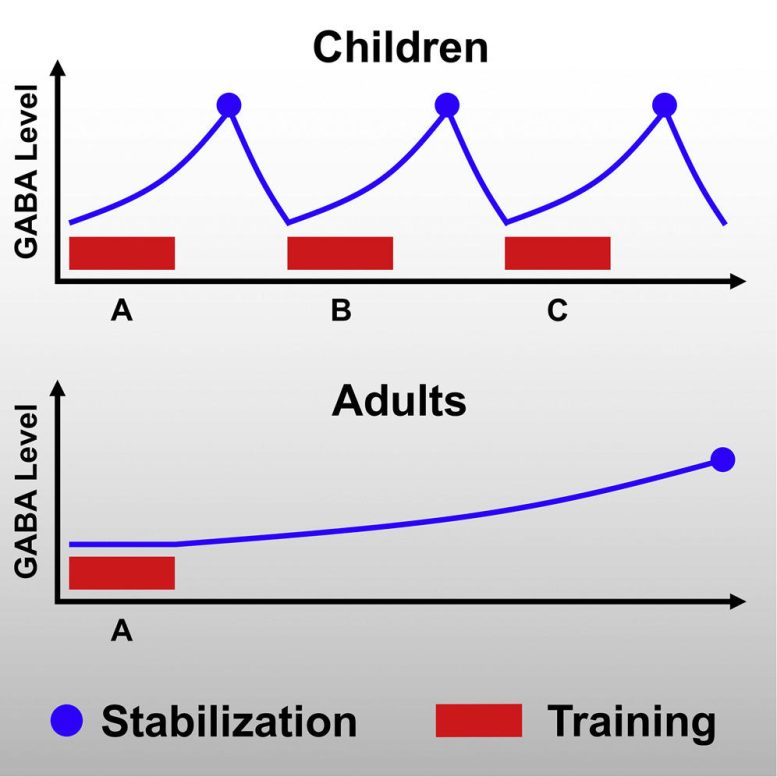
According to the study, children experienced a rapid increase in GABA during visual training, which lasted even after the training ended. In contrast, GABA concentrations in adults remained constant during training. These findings suggest that children’s brains are more responsive to training, allowing them to quickly and efficiently consolidate new learning.
“It is often assumed that children learn more efficiently than adults, although the scientific support for this assumption has, at best, been weak, and, if it is true, the neuronal mechanisms responsible for more efficient learning in children are unclear,” Watanabe said.
Differences in GABA were one obvious place to look for answers. While previous studies already had, the researchers noted that GABA in kids had only been measured at one time-point. It also wasn’t measured at a time that had any special significance in terms of learning.
So, they set out in the new study to see how GABA levels change before, during, and after learning. They also wanted to see how that differed between kids and adults.
Differences Between Kids and Adults in GABA Response
The study examined visual learning in elementary school-age children and adults using behavioral and state-of-the-art neuroimaging techniques. It found that visual learning triggered an increase of GABA in children’s visual cortex, the brain area that processes visual information. That GABA boost also persisted for several minutes after training ended.
What they saw in adults that were offered the same visual training was notably different. In adults, there were no changes in GABA whatsoever.
The discovery predicts that training on new items rapidly increases the concentration of GABA in children and allows the learning to be rapidly stabilized. Further experiments also supported this.
“In subsequent behavioral experiments, we found that children indeed stabilized new learning much more rapidly than adults, which agrees with the common belief that children outperform adults in their learning abilities,” says Sebastian M. Frank, now at the University of Regensburg, Germany. “Our results, therefore, point to GABA as a key player in making learning efficient in children.”
Rethinking Brain Maturity and Cognitive Functions
The findings suggest that children are likely to acquire new knowledge and skills more rapidly than adults, they say. It should add further encouragement for teachers and parents to give children many opportunities to acquire new skills, whether that’s learning their times tables or riding a bike.
The findings also may change neuroscientists’ conception of brain maturity in children.
“Our results imply that children exhibit highly efficient inhibitory, GABAergic processing in spite of inhibitory failures that have been observed in other domains such as cognitive control or attention,” Frank said. “This implies that GABAergic processing involved in different aspects of cognitive function might mature at different speeds.”
“Although children’s brains are not yet fully matured and many of their behavioral and cognitive functions are not as efficient as in adults, children are not, in general, outperformed in their abilities by adults,” Watanabe added. “On the contrary, children are, at least in some domains such as visual learning, superior in their abilities to adults.”
They say such differences in maturation rates between brain regions and functions should be examined in detail in future studies. They also want to explore GABA responses in other types of learning, such as reading and writing.
Reference: “Efficient learning in children with rapid GABA boosting during and after training” by Sebastian M. Frank, Markus Becker, Andrea Qi, Patricia Geiger, Ulrike I. Frank, Luke A. Rosedahl, Wilhelm M. Malloni, Yuka Sasaki, Mark W. Greenlee and Takeo Watanabe, 15 November 2022, Current Biology.
DOI: 10.1016/j.cub.2022.10.021
The study was funded by the Fred M. Seed Foundation, the United States – Israel Binational Science Foundation, the National Institutes of Health, the Deutsche Forschungsgemeinschaft, and an Emmy Noether Grant.
Never miss a breakthrough: Join the SciTechDaily newsletter.
Follow us on Google and Google News.
6 Comments
Lol kids may pick things up quicker these days for a variety of reasons. But I would not call them “smarter”…smoking tide pods and deep frying Cali cheeseburgers is proof of this.
Yes today’s kids are definitely smarter. Every new generation is smarter than the older it is simply our gears. This is why we are where we are today. Simple human evolution no research required just look at human history.
They ARE smarter in the new generation but I wouldn’t consider them being smarter than us adults though they can pick up information quicker than us!
Yes, it’s true! I am a child and I can learn faster than my parents!
They are smarter in the new generation but I wouldn’t consider them smarter comparing to us adults although they can take information in their brain quicker🧠
Kids are really smart.